How to Spot Fake Perfume: Red Flags Before You Buy
 By Laura Jordana · Editor
Published Oct 10, 2026 · 4 min read
In this guide
Counterfeit perfume is not a niche problem. It moves in commercial quantities, often mixed in with real goods, and the listing usually looks fine until the bottle arrives. Here are the checks that actually help, in the order worth doing them.
What a real seizure looks like
On April 20, 2026, US Customs and Border Protection announced that officers at Port Everglades in Fort Lauderdale had seized more than 8,500 units of counterfeit perfume. According to CBP’s release, the shipment came from Singapore, was headed to an address in Miami, and the fakes were mixed in with legitimate products. Officers first inspected it on February 10 and seized it on April 2.
| Detail from CBP’s release | Figure |
|---|---|
| Counterfeit perfume units seized | 8,500+ |
| MSRP had the goods been real | $1,010,940 |
| Brands copied | Gucci, Burberry, Armani, Lancome |
| Origin | Singapore |
The mix is the lesson. When fakes ship alongside real stock, a seller can pass inspection on some bottles and still ship you a fake. CBP’s advice in the same release is to buy authentic products from reputable retailers, and it warns that counterfeits can pose potentially serious health and safety risks.
Red flags in the listing and the seller
Most fakes are caught before you buy, by looking at the listing rather than the bottle.
- Price far below what established discounters charge for the same size. Compare a few stores before trusting a deal.
- A marketplace seller with few ratings, a new account, or reviews about other product types.
- Stock photos only, or photos that do not match the size or version in the title.
- Vague wording such as “designer type” or “impression” sitting next to the real brand name and logo. A legal dupe uses its own brand; see perfume dupes and clone houses.
- No return policy, or one that excludes opened items with no exception for counterfeits.
Red flags on the box and bottle
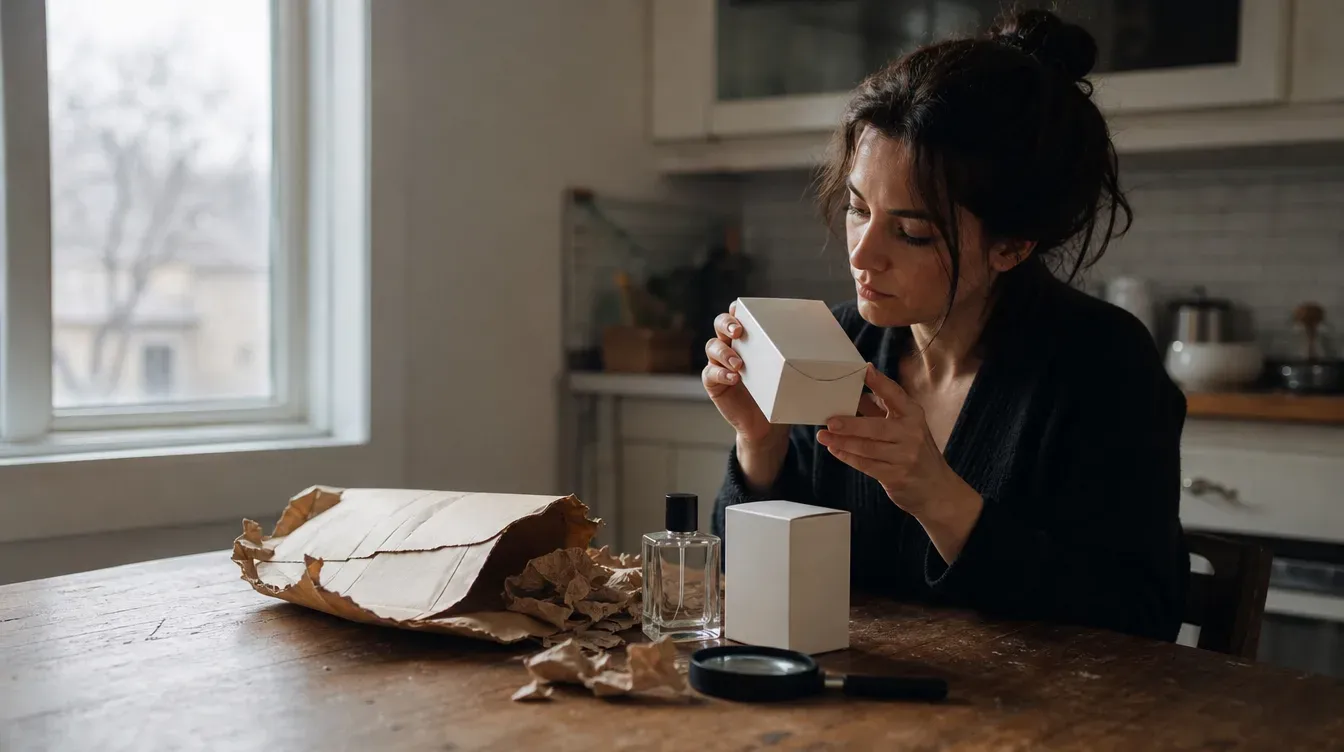
These checks catch sloppy fakes. Good ones copy the outside closely, so passing them does not prove a bottle is real.
| Check | What looks off |
|---|---|
| Cellophane | Loose, wrinkled or thick, with messy glue seams |
| Box | Thin card, blurry printing, misspellings |
| Batch code | Missing, or the code on the box does not match the one on the bottle |
| Bottle | Uneven glass, crooked label, cap that sits loose |
| Juice | Color clearly different from a store tester |
| Sprayer | Leaks, spits, or the tube is visibly too long |
Note that missing cellophane alone is not proof. FragranceNet’s FAQ says some of its items arrive without cellophane or as testers, and that a tester holds the same fragrance as the retail version with different outer packaging.
Red flags when you smell it
Compare it with a tester in a store if you can. A fake may open with a harsh alcohol smell and fade within an hour or two, or smell flat after the first spray. Smell is the least reliable check, though, because the original may have been reformulated and your nose adjusts quickly. If anything irritates your skin, stop using it; that is reason enough without proving the bottle is fake.
Where to buy, and the US vs Canada difference
Worth it if: you buy from the brand, a department store, a beauty chain or a discounter that publishes its sourcing and return terms. Skip it if: the only seller offering the price is a marketplace account you cannot trace.
In the US, CBP handles counterfeit seizures at the border and posts releases on its newsroom. If a marketplace order turns out to be fake, use the platform’s counterfeit claim process first, then your card issuer.
For the discounters people ask about most, read are FragranceNet and FragranceX legit. If you just want to try a scent cheaply, a sample from a known seller is lower risk than a cheap full bottle; see the decants and samples guide.
Sources checked October 2026: CBP Fort Lauderdale counterfeit perfume seizure, April 20, 2026, FragranceNet about us and FAQ.
Frequently asked questions
What is the biggest sign a perfume is fake?
The seller, more than anything on the bottle. A designer fragrance listed far below what discounters charge, by a marketplace seller with no history, is the most common setup. Packaging checks help, but good fakes copy the box closely.
Can fake perfume be harmful?
US Customs and Border Protection warns that counterfeit goods can pose potentially serious health and safety risks to consumers, because nobody checks what goes into them. If a fragrance irritates your skin, stop using it.
Are testers and unboxed bottles fake?
Not by definition. FragranceNet's FAQ says a tester contains the same fragrance as the retail version and the main difference is the outer packaging. The risk is who sells it: a tester from an established retailer is a different bet from one sold by an anonymous marketplace account.
What should I do if I think I bought a fake?
Stop using it, photograph the bottle, box and listing, and ask the seller or marketplace for a refund under its counterfeit or not-as-described policy. If you paid by credit card, your card issuer may also open a dispute.